
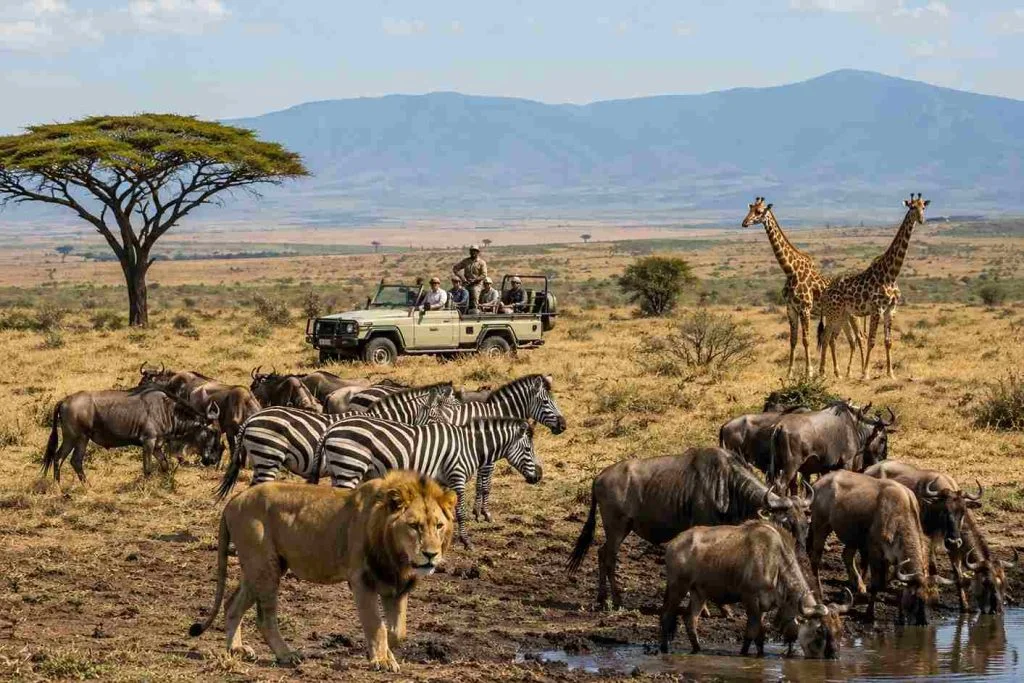
Tanzania safaris give you the chance to observe an incredible amount of wildlife. Guests can see the iconic “Big Five.” These are lions, leopards, African elephants, Cape buffaloes, and black rhinoceroses. They can also encounter herds of wildebeests, zebras, and giraffes. The country is also home to hundreds of bird species. Tanzania’s protected ecosystems support the most spectacular animal populations.
Critical Takeaways
- Tanzania is one of the best locations in Africa to view the Big Five in their natural habitats.
- Over two million wildebeests, zebras, and gazelles move through the Serengeti every year. In a never-ending quest for new pasture, they follow in the footsteps of the Great Migration.
- Tanzania hosts high concentrations of large carnivores. Safari goers can see top predators like lions, cheetahs, and spotted hyenas.
- The country has over 1,000 recorded bird species. It’s why Tanzania is a paradise for migratory species and birdwatchers.
- Parks have their own distinct specialization. The different conservation areas offer unique Tanzania wildlife highlights. Guests should visit several parks to complete the wildlife experience.
Wildlife Encounters in Africa: From Tarangire to Serengeti
Tanzania’s national parks and conservation regions are home to hundreds of species of wildlife. Their interactions are different in each place, from Tarangire to the Serengeti.
-
African Elephant
Tarangire National Park is noted for its large herds of elephants. During the dry season, the animals like to cluster around the Tarangire River. Visitors can observe their complex familial behaviors as they move among baobab trees.
-
Lions
The Serengeti is home to one of the largest continuous lion populations in Africa. Experts like GAIA Legacy Travel estimated there are several thousand lions in the park. Travelers often spot large, multi-generational prides resting on granite kopjes. They can even see lions tracking their prey across the expansive savannah.
-
Wildebeest and Zebras
These two herbivores are the backbone of the Great Migration. They go through a cycle across the wide plains in unison. Witnessing their massive columns gives visitors a profound look at the planet’s largest mammalian migration.
-
Leopards and Cheetahs
The Serengeti offers visitors excellent opportunities to spot these specialized big cats. They can observe them in their unique survival adaptations. Travelers can witness cheetahs use their explosive speed on the flat, open grasslands. But leopards are often found draped over the branches of acacia trees.
-
Black Rhinoceroses
The black rhino is the most endangered member of the Big Five safari. It’s highly protected and challenging to find in the wild. But safari guests can have the chance to see them in the Ngorongoro Crater.
-
Masai Giraffes and Hippopotamuses
The Masai giraffe is Tanzania’s national animal. Guests can see herds of them across both Tarangire and the Serengeti. These giraffes are usually seen browsing around the tall acacia canopies. The area’s river systems and deep mud pools host dense pods of hippopotamuses. They’re often seen wallowing to protect their skin from the equatorial sun.
Bird life in Tanzania
Tanzania is also a major destination for bird watching. More than 1,000 kinds of birds are found throughout the country’s marshes, woods, and grasslands.
Travelers are usually treated to sightings of ostriches, eagles, and kingfishers. Hornbills and flamingos are also abundant. Lakes such as Manyara and Natron attract large numbers of water birds. This allows for good viewing experiences for tourists.
Frequently Asked Questions
When is the ideal time of year to go on a safari in Africa?
The dry season is frequently regarded as the best period for game viewing. The season runs from June until October. During these months, vegetation thins out. Water sources also diminish, forcing Tanzania wildlife to go to permanent rivers and waterholes.
Will safari goers get to see all the Big Five animals?
There’s no guarantee that visitors will see all the Big Five safari animals. Tanzania has healthy numbers of these animals, but they are still unpredictable. The black rhinoceros remains rare and elusive. Visitors have a better chance of seeing them if they go to the Ngorongoro Crater.
Where can visitors see the Great Migration river crossings?
The dramatic river crossings usually happen between July and October. The spectacle of wildebeests facing off against Nile crocodiles happens in the northern Serengeti. The herds try to cross the Mara and Grumeti rivers into Kenya’s Maasai Mara.
What should visitors expect about bird watching on safari?
Tanzania is an exceptional birding destination. It has more than 1,000 resident and migratory species. Bird watching peaks from November to April. This is when European and North African migratory species arrive. It also coincides with the breeding season when resident birds display vibrant plumage.


